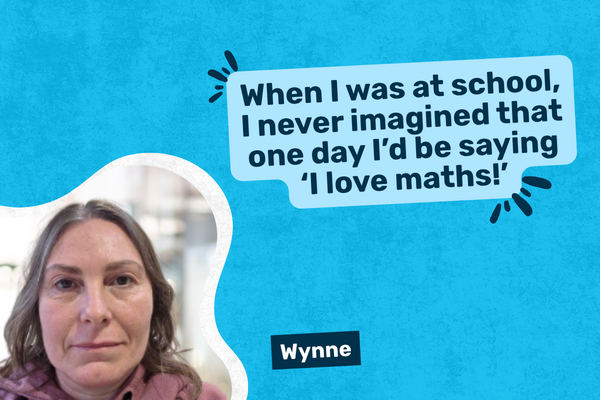
Having failed GCSE maths at school, Wynne Hindle promised herself she’d do better if she got the chance later in life. That chance came when she needed the qualification to progress in her career.
Wynne told National Numeracy about her traumatic experience with maths at school, her avoidance of numbers in adulthood and how she took on the challenge of maths GCSE again, aged 52, and the benefits gaining new confidence and skills has brought.
From a young age, Wynne experienced maths anxiety. “When I was at school I used to feel dread whenever I had maths on my timetable and walked into lessons feeling very, very anxious at the thought of having to do it,” she explains. “I had a lot of anxiety about maths and would try and avoid doing it if I could.”
Scared to ask for help with maths
One experience in particular, when she was around nine years old, is one that really sticks in her memory. “At school we used to focus a lot on mental arithmetic and I remember really struggling with having to listen to the question then work out the sum in my head,” Wynne recalls.
“We did a quiz and I had to give mine to the girl next to me to mark. She told the teacher I’d hardly answered any questions and the two I had answered were wrong.
“So the teacher made me go up and do every single question on the board in front of everyone. She just watched and shouted at me and told me I wasn't trying and that's why I hadn’t done it.
“I felt like I was being shamed because I struggled with it. I found it really difficult to understand maths and I was scared to ask for help because I thought I might get shouted at.”
Avoiding numbers in everyday life
The fear of maths followed Wynne into adulthood and affected her everyday life. “I would try and avoid anything that involved working things out in my head,” Wynne says. “If I had to calculate a tip in a restaurant for example, if someone else could do it, I'd let them because that was easier for me. I did feel incredibly stupid, like I was the only one who couldn't do it. Everyone else around me seemed to do it quite easily, but I couldn’t.
“Quite often when I was working out my children's dinner money, I would add up how much I owed incorrectly and send in random amounts of money to school.
“I used to have a lot of anxiety about shopping and working out whether I'd got enough money too,” she adds. “When using cash I used to worry I was going to get to the till and then wouldn't have enough and would have to put some back.”
Helping her children with their maths homework also caused Wynne to use avoidance tactics.
“I could help them up to point, but when it came to GCSE maths, that's when it became more complicated. I used to have a look at it then say: ‘Go and ask your dad.’”
A new way of learning maths
Having worked as a nanny and nursery nurse, Wynne later set her sights on becoming a Learning Support Officer, but this would mean confronting her fear and returning to GCSE maths.
“I got a grade G for GCSE maths when I was 17 and promised myself if I ever got the chance I would have another go as an adult,” Wynne says. “With my children doing their GCSEs and A levels they encouraged me to go back, so I did.”
She studied for and passed, Functional Skills Maths level 2, before signing up for GCSE maths at West Suffolk College, where she found the learning experience much more relaxed than during her school days.
“I really got on with my teacher,” Wynne continues. “She helped me realise that I actually do quite like maths and that I am a numbers person.
“Sometimes if I didn't get things, she tried to explain it in a different way, or she would draw the problem out so that I could see it in a more visual sense, which made a big difference.”
If at first you don’t succeed…
The first time Wynne took the exam she didn’t pass, but kept going until she got the result she wanted, on the fifth attempt. “Some of the exam papers felt very, very challenging to the point where I felt like I didn't want to do it anymore, I wanted to walk out. But then I calmed myself down and kept going,” Wynne recalls.
“The first time I took it I saw it as a stepping stone, something to build on. But with the other times it was crushing when I saw my mark had gone up a little bit, but I still hadn't quite made that grade four. But I felt I had to just get back on the horse and come back and give it another go each time, because if I quit, I wouldn't know what I could have achieved.”
“I am quite a resilient person and it was hard work, but I just kept going because I knew I'd probably get there in the end,” she explains.
“When I found out I had passed, I had to keep looking at the email just to confirm that I did actually pass! It still doesn't feel real now.”
Developing a love for maths
Passing GCSE maths has not only opened up new opportunities for Wynne in terms of career prospects, but made her everyday life easier too. “I feel a lot more confident about everyday maths now,” she smiles. “I've developed a love for maths!”
“I used to feel really stupid with numbers, but now I feel good with them. I feel more confident now, especially when shopping – I can look at prices and match them and see which one's the better offer.
“Now I understand the maths better and can work with it I feel more confident in myself too. I’d also feel more confident helping my granddaughter with her maths,” Wynne adds.
“My story has gone viral and I’ve had lots of positive comments online from people saying I’ve inspired them to go back to GCSE maths. I would encourage others to go back and have another go because there is more support now and the benefits include feeling more confident in day-to-day life around numbers.
“When I was at school, I never would have imagined that one day I’d be saying ‘I love maths!’”