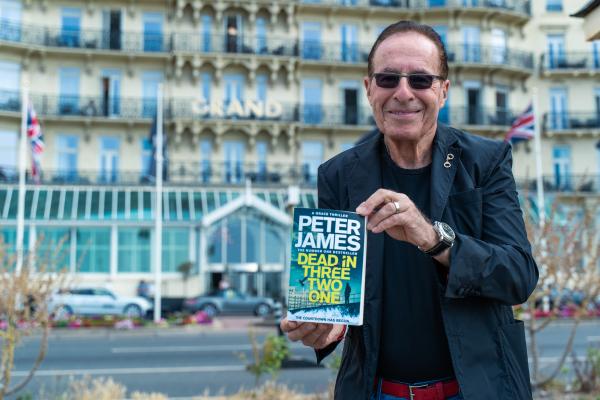
In advance of Number Confidence Week and as he publishes his latest novel, Dead in Three Two One, Peter caught up with National Numeracy’s Louise Purser to explain the significance of the book’s title and how numeracy is still an integral part of his writing process as well as producing the ITV drama series starring John Simm as DSI Roy Grace.
What is the significance of your new book's title, Dead in Three Two One?
The significance of the title is a double significance in fact, it is the room number of a hotel room in Brighton where somebody is going to be staying and it is a hotel room where there is going to be a bomb planted and ‘three two one’ are the final numbers of the countdown.
How does protagonist DSI Roy Grace use numeracy in this case and others?
Roy Grace uses numeracy both in this case and throughout all the cases in many different ways. Every major crime, every homicide, is a huge puzzle of hundreds if not thousands of pieces that have to be very painstakingly put together. Numeracy plays a huge part in all crime investigation, particularly in major crime like murder.
As part of your research for this latest book, you worked at a hotel, was there much numeracy involved?
There was in all kinds of ways. I actually spent a day as a uniformed concierge. My nicest bit of numeracy was when I saw an elderly couple struggling with their bags, so I carried them out for them and put them in the car and I got a £5 tip!
There is quite a lot of numeracy in hotels because of course every hotel room has a number and they're referred to by the numbers and as a concierge you should know which room is which, is it a little single room, is it a grand suite? Numeracy in hotels is everything in so many ways.
There's a huge amount of numeracy involved in timing. Hotels run on clocks: breakfast service, lunch service, tea service, dinner service, bar service, event times. The bigger the hotel, then the more reliant on timing it is.
As executive producer of the ITV drama series Grace, can you tell us about the numeracy involved in planning and producing the series?
The numeracy involved in producing a television series like Grace is massive because there are so many moving parts. Starting with the locations and all the logistics of the crew, 50, 60 crew members that have to be allocated to different parts, different locations.
When you're filming, a lot of filming is done out of sequence. Every scene has to be numbered so that you as producer, the cast as actors, the director as the director, know in which order something is happening.
If a character has just been told the news that their loved one has been murdered, but we're actually filming it out of sequence, the actor has got to remember how their character was emotionally at that time. Numeracy comes into play in so many different ways.
How useful is numeracy to you in everyday life?
I was completely innumerate at school, I failed maths O level three times. What annoyed me was that none of the teachers who taught maths ever said everything in the entire world is dependent on mathematics.
The chair I'm sitting in right now, if it wasn't for mathematics it would fall over. Every single thing in the universe, the reason that we exist on our planet is because of the exact distance the sun is from this planet, the solar system is from this planet, and it is all about numeracy and mathematics. We live in a world in which numbers are everything and nobody tells you that.
Every single day I'm writing and I have a strict writing routine in the evening, 6 to 8.30 at night, and I write a thousand words. I pretty much stop when I've got to a thousand words and then the next day I edit and I'll expand. It'll become 1,400 to 1,500 words. Every Saturday I have in my calendar the word count I want to get to to be on target to finish the book on time, so numbers are a big part of my world.
I think mathematics in our everyday life is so important. It’s checking what the best bargain is in Tesco or Lidl or Asda or whichever supermarket. How much money have I got left in my bank account? How much interest am I paying on my credit card?
You look at driving your car and the display comes up: how much further can you go without filling up your tank or recharging the electricity? Maths is around us all the time.
What would you advise anyone who'd like to improve their numeracy but doesn't know where to start?
My advice is to do little puzzles yourself. I was told that if you want to improve your mental state, count down from 100 first thing in the morning when you wake up or if you're going to sleep at night. I find that's really good, it helps sharpen your brain.
I often do things like crosswords and there you have numeracy because you've got to work out if 14 down fits with seven across etc. And Sudoku – things like that, do anything where you're slightly challenging yourself.
Thanks so much, Peter!
Photo credit: Callum Cutler