The webinar was a great example of a Big Number Natter, a conversation to get people talking about their feelings about maths.
Opening up about your relationship with numbers is the first step towards improving number confidence and skills and the Big Number Natter is a key part of this year’s National Numeracy Day on 20 May.
What are the symptoms of maths anxiety?
We know maths anxiety is widespread. While some of us may not think twice about checking our bank statement, adding up the total of some shopping or being asked to carry out a maths task at work, for others the prospect of having to confront numbers can evoke mental as well as physical symptoms.
Dr Hunt explained how these can include a sense of panic or helplessness as well as feelings of tension, apprehension and dread.
Interestingly, maths anxiety is not linked to intelligence or ability, yet it can cause people to avoid situations involving the subject.
Emotional regulation of maths anxiety
When faced with symptoms of maths anxiety, it’s important not to feel rushed. Dr Hunt suggested several techniques which may help:
“We know that if you’re maths anxious, that anxiety can get in the way, it can supersede your ability to remain focussed on the task at hand.
“Relaxed breathing for example – there are lots of different activities around relaxed breathing, and particularly diaphragmatic breathing as well, so learning how to use your diaphragm to breathe more effectively.
“Various mindfulness activities can be helpful and even things like mindful colouring and listening to music…one of the key things here is thinking about what works for any given individual.”
How can teachers help with maths anxiety?
Dr Hunt suggested several teaching methods which could help alleviate the symptoms of maths anxiety.
Co-operative learning or group work can help provide a support network, while the ‘gamification’ of calculation problems can make maths fun.
He also emphasises the importance of supporting school staff with maths confidence, not only for their own benefit, but the students’ too:
“We know from some quite big projects now that how students feel about their teachers, how they perceive their teachers, can be really important, not just for their own attainment, but how they feel about maths as well.
“There was a study a few years ago and when they focussed on the individual students, the strongest predictor of maths anxiety was how competent they perceived their teacher to be.
“And when they looked at the teachers, the greater the confidence reported by the teachers, the lower the maths anxiety reported by the students.”
It’s good to talk about maths anxiety
When asked how older learners could be supported, Dr Hunt said just getting together and talking about maths experiences can be useful and how – just like with the Big Number Natter – you may be surprised that others feel the same way as you:
“One of the – almost therapeutic – things I see is where you’ve got a group of individuals who sit down for an hour and they just start chatting about their feelings towards maths.
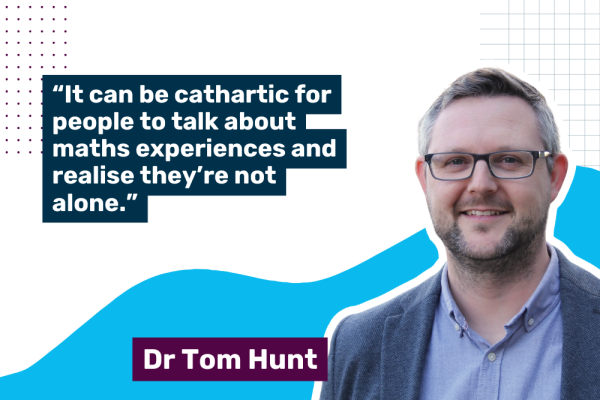
“As long as you facilitate that conversation it can be quite cathartic for people to just talk about previous maths experiences, to almost offload some of the thoughts that they have about their own self-belief, and to realise actually it’s not just them, they’re not alone.
“It’s often surprising to people to find that others are in a similar boat.”
The webinar was a friendly introduction to maths anxiety with lots of useful information.
To learn more about Dr Hunt’s Maths Anxiety Research Group at the University of Derby, visit: marg.wp.derby.ac.uk
You could start your numeracy improvement journey today
Numeracy is a skill essential to daily life, why not start improving your number skills and confidence with our free website, the National Numeracy Challenge? It’s full of everyday maths questions and helpful resources.
National Numeracy Day on 20 May has the theme of Count On Your Community. To learn more and sign up, visit the National Numeracy Day homepage.