
A new report from Barclays, commissioned in partnership with independent charity, National Numeracy, reveals that 2.1 million children across the UK are likely to be at risk of low number confidence due to the ripple effect from their parents and carers.
The report, Nurturing Number Confidence: The role of public policy in building number confidence between the generations, explores the intergenerational link between parents' and children's number confidence. It found that 16 per cent of parents reported low confidence – amounting to 2.1 million children with at least one parent with low number confidence.
A lack of number confidence is known to have negative knock-on effects on people's earnings, employment and ability to manage their money.
Research by National Numeracy shows that nearly one in five people (18 per cent) avoid applying for a job or qualification because it, or the interview process, involves maths. Furthermore, low number confidence is associated with lower actual mathematical skill levels, which in turn are linked to lower earnings in the workplace*.
Further research from Barclays shows that half of Brits recognise that areas of their money management would improve if their number skills were stronger. According to Pro Bono Economics, low number confidence could be costing the UK economy up to £25bn per year.
Of those parents who reported low number confidence, 49 per cent cite helping their children as a driver to improve their own skills. Of the activity that builds number confidence in parents, explaining the application of maths in everyday life to their children is the most influential, and increases the number confidence of children too.
The Government recently announced its Curriculum Review which will make financial literacy education compulsory for both primary and secondary school pupils. This marks a significant step forward towards a more financially and number confident nation. However, Barclays and National Numeracy believe the Government can go further by adopting a series of recommendations to nurture number confident communities and to build on what is already taught in schools:
- The government should have a policy of parity between the way that literacy and numeracy are promoted to include a National Year of Numeracy to follow in due course the 2026 National Year of Reading.
- Government-funded curriculum providers of mathematical classroom content should be additionally resourced to create complementary digital tools for parents and carers to support their child's learning including through building their own number confidence.
- Non-statutory guidance from government to schools should outline best practice for building number-confident wider school communities.
Vim Maru, CEO of Barclays UK said, "Confidence with numbers is the bedrock of financial confidence. Our report shows how parents' low number confidence ripples through to their children, but also how teaching kids can boost parents' own skills. Getting this intergenerational exchange right is key to building number confident communities.
"We're encouraging government to build on what is already taught in schools and bring parity between how literacy and numeracy are supported at home, develop digital resources to support parents when needed and extend guidance so schools can foster number confidence beyond the classroom."
Sam Sims, CEO of National Numeracy said, "Number confidence influences so much of our lives, from how comfortable we feel managing money to the choices we make about work, learning and opportunities. This report shows the powerful intergenerational impact of number confidence: when parents and carers lack confidence with numbers, it can inadvertently hold children back too. But it also highlights a real opportunity. Supporting adults to build their number confidence can have a lasting positive effect across generations and on the whole family. That is why, working with Barclays, we are calling on the Government to bring parity between how literacy and numeracy are supported at home, and to back the tools and guidance that parents, carers and schools need to build number confident communities."
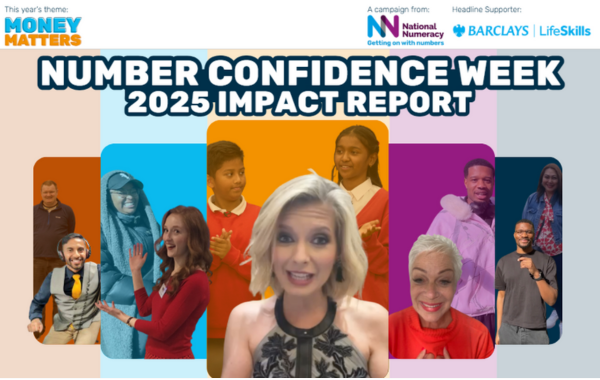
The report is part of the ongoing partnership between Barclays LifeSkills and National Numeracy through which they are working together to boost the UK's number confidence. This includes supporting communities where the need for number skills is the greatest by training up a Numeracy Champion in more than 60 primary schools in communities across the UK, with the aim of reaching over 13,000 children, parents, carers and staff.
Alongside this, Barclays LifeSkills has created dedicated resources to support all ages with their number skills.
Read the full Barclays report created by Barclays' Group Policy Development team, Nurturing Number Confidence, here. Barclays' Group Policy Development team creates public policy thought leadership content on behalf of Barclays. The work draws on the Bank's expertise, data and insights, and is intended to inform the design and application of public policy solutions in response to pressing economic and societal challenges.
*Pro Bono Economics suggested in 2021 that the average worker in the UK with low numeracy skills is currently earning around 6.5% less than they would if they had a basic level of numeracy skills – the equivalent of nearly £1,600 less per year (Pro Bono Economics, Counting on the recovery, April 2021).
Notes to editors
Research conducted on behalf of Barclays by YouGov between 23rd September – 6th October 2025, surveying 4080 UK parents (n=2040) and their children aged 5 – 16 years old (n=2040). Results were weighted to be representative of UK parents by age, gender and region.
References
- Barclays, Nurturing Number Confidence, January 2026
- National Numeracy, New research: Make National Numeracy Day count!, May 2021
- National Numeracy, Building a numerate nation: confidence, belief and skills, November 2019
- Pro Bono Economics, Counting on the recovery, April 2021
About Barclays LifeSkills
Launched in 2013, Barclays LifeSkills helps people to build the confidence, knowledge, connections and core transferable skills they need to succeed at work, thrive in the digital/AI age and better manage their money.
It is vital that the UK workforce is prepared with skills, such as communication, problem solving, creativity, resilience, adaptability, proactivity, leadership, networking, CV writing, interview and money skills, for a world of work where, due to the speed of change, we are unable to accurately predict what the jobs of the future will look like and what technical skills will be needed.
Designed for all ages, from children and young people aged 5+ to adults and families, LifeSkills has supported millions of participants and placed thousands into work through collaboration with the education sector, respected charities, and the business community. The programme has also supported some of the UK’s most underserved and underrepresented communities to tackle barriers they face getting into and staying in work
About National Numeracy
National Numeracy is a charity dedicated to helping people feel confident with numbers and using everyday maths. We empower people to thrive by using numeracy to open up opportunities and access brighter futures, targeting communities where the need is greatest.
National Numeracy is a registered company (company no: 7886294) and charity (charity no: 1145669). Visit: www.nationalnumeracy.org.uk
About Barclays
Our vision is to be the UK-centred leader in global finance. We are a diversified bank with comprehensive UK consumer, corporate and wealth and private banking franchises, a leading investment bank and a strong, specialist US consumer bank. Through these five divisions, we are working together for a better financial future for our customers, clients and communities.
For further information about Barclays, please visit our website home.barclays
Photo credit: sofatutor, Pexels