Creating a coalition for a Year of Numbers
An alliance spanning business, education, health, finance, sport, culture, technology, media and civil society will help inspire people across the UK to discover the relevance and power of numbers and data through engaging experiences, education and everyday opportunities. We are partnering with Barclays LifeSkills to form the coalition, which follows the policy report and recommendation we released earlier this year, Nurturing Number Confidence.
We have written to the Secretary of State for Education, Lucy Powell, Secretary of State for Work and Pensions Pat McFadden and the Chancellor John Healey with invitations to explore how the Government might support this initiative, as it has with the current Year of Reading.
Sam Sims, CEO of National Numeracy said: "Creating a numerate nation can help build a prosperous society in which individuals, families and communities thrive. We believe it’s high time for a national movement to change attitudes so that people of all ages understand the lifelong value and benefits of numeracy.
"A National Year of Numbers can inspire positive action to create a nation that is empowered and equipped to take action to improve their number confidence and numeracy skills and boost social mobility to help build a thriving, productive society."
Tackling the UK's numeracy crisis
The UK is in a numeracy crisis with significant economic and social costs, especially for those least advantaged in society.
The OECD classes England as a ‘numeracy gap country’: one of just three countries with above average literacy, but lower than average numeracy. And 25% of adults with an A-Level or equivalent education level have low numeracy. Almost half of all working age adults have the numeracy level of a primary school child.
Our own research shows:
- There are widening regional disparities, with numeracy skills weakest in regions whose incomes are lowest.
- Low numeracy acts as a brake on the UK’s growth: it costs us up to £25bn a year.
- Numeracy is more important in the AI-driven economy, not less.
Tackling the numeracy crisis across society – from classrooms to workplaces, community hubs and beyond, will help us rise to this challenge. It is both a national necessity and a national opportunity.
For far too many young people, the current GSCE system can lead to the unintended consequence of a devastating loss of confidence in understanding and working with numbers for hundreds of thousands of school-leavers every year.
We have been working for many years with the millions of adults for whom low numeracy has blighted their lives, their opportunities in life, and those of their children and communities. We know this lack of confidence and sense of failure and shame around numbers can last a lifetime.
Mokbul's success story
Mokbul, one of our beneficiaries, had always dreamt of working for the Ambulance Service but didn’t have the required maths GCSE. Thirty years later, his dream came true after working with our charity. "At school I felt maths was pointless. I didn’t understand the importance of it," he said. "But with the support of Numeracy Champions, my perspective changed. I now have the potential to advance my career and I’m looking forward to the opportunities ahead!"
The challenge is not simply that too many young people struggle with maths. It is that we have not always been sufficiently clear about the value of maths in everyday life, about why being numerate matters, and how it should be developed throughout every single young person’s education and on throughout adult life.
We want the UK National Year of Numbers to inspire every person to develop the confidence and competence to use numbers in their education, work and everyday life.
A national focus to deliver powerful change
A Year of Numbers could provide national focus to deliver powerful change. Rather than presenting numeracy solely as a problem to be addressed through system reform, it would present it positively: as a fundamental life skill, a source of confidence and a foundation for opportunity for the millions, like Mokbul, whose opportunities in life have not been realised due to a lack of number confidence.
If your organisation would be interested in joining the coalition to build a UK National Year of Numbers, please get in touch by emailing:
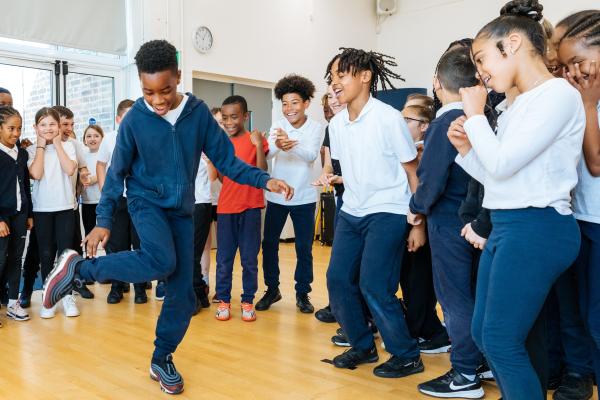
Photo: Connecting dance and numeracy at Rosetta Primary School as part of National Numeracy Day