National Numeracy, along with partner Barclays, is calling for a National Year of Numeracy and is now going further, building a coalition to bring this to fruition.
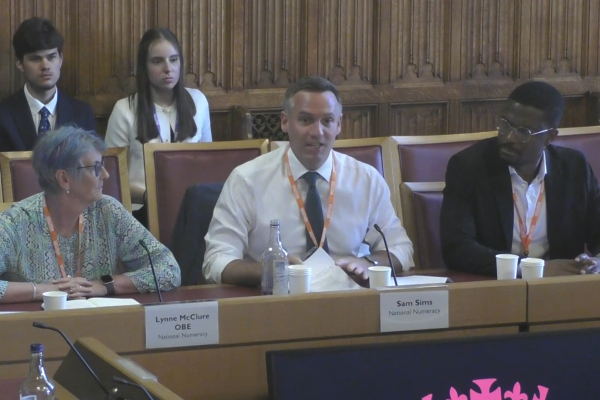
National Numeracy Ambassador Bobby Seagull also provided evidence at a previous session, while National Numeracy partners Barclays, Compare the Market, and NHS England took part in a roundtable discussion with the committee to give employers’ views on the numeracy of the workforce of today and tomorrow. Earlier on in the hearing, Rishi Sunak and his Richmond Project colleagues gave evidence based on their work and research.
The numeracy problem in the UK
In his opening statement, Sam Sims outlined the current numeracy climate in the UK, according to National Numeracy’s years of research and working with the population. “This is a critical national issue experienced at some scale,” Sam said. “It affects women more than men, when it comes to confidence and maths anxiety, and we know this holds people back. We also know it’s changeable.”
The problem with culture, Sam said, is that not that many adults with low numeracy say they want to improve. “They either don’t see the need to do that, or how it would benefit them. The second of those is absolutely key to how we start changing this culture.”
It’s an issue of demand, not supply
On being asked what needs to happen for a sustained, accessible comprehensive adult education offer, Sam said that previously the issue was “incorrectly diagnosed” as “let’s put on more courses, give people more things to do.”
“The problem is it’s not a supply issue when we talk about adult learners,” Sam continued, “it’s a demand issue, primarily. We have to recognise that.”
Rotimi Merriman-Johnson, National Numeracy Ambassador and Financial Educator, added: “If we are assessing numeracy, we [need to] make confidence at the heart of that.”
The role of employers
The panel discussed the role of employers in supporting numeracy confidence in the workplace. Rotimi said there is a huge opportunity for investing more in numeracy as a pillar of employee wellbeing.
Adding to this, Sam said, “Employers should care about this issue, because it will benefit them to care about it. It can help create a more productive workforce, the evidence shows, and a more agile workforce. It has a significant impact around careers.”
Sam added that there are employers already making a difference – such as those on the National Numeracy Leadership Council, who have created the Numeracy for Equality pledge.
How we can help low achievers and those getting left behind
Lynne McClure OBE, National Numeracy Trustee and Chair of Mathematics curriculum drafting group at Department for Education, said that work needs to begin in early years, as that has a significant knock-on effect.
Rotimi spoke from personal experience about secondary school being a point where a lot of children choose to leave maths behind, as a result of streaming and confidence being knocked.
Lynne added that Year 7 is a pivotal year: “We know that students’ liking for maths does a deep dive, and if they are kids with a low socioeconomic background, they are unlikely then to ever pick up maths again, whether those who have got a background of parental support will probably stick with it.”
The use of technology, and new research into AI and numeracy
The panel also discussed how numeracy policy should adapt to reflect technological advances.
Sam said, “We are very much in favour of the use of technology, but […] it should accompany having those fundamental numeracy skills and confidence in place. It should be used in conjunction, so that you know firstly that what you’re putting in is the right query, and secondly to be able to know that what you’re getting out is likely to be accurate.”
“We, alongside research organisation Policy Connect, KPMG and businesses of the National Numeracy Leadership Council, have undertaken some research on AI, numeracy and social mobility, and this is due to be published in less than two weeks, so we’ll have a lot more to share around those interdependencies very shortly.”
Next steps
Finally, the panel asked for one key solution to our numeracy challenges. Sam said, “We need to change how people see, feel and understand the value of numeracy in their everyday lives. This is going to take a massive effort across every sector of society, if we’re going to change that culture.”
“We collaborated with Barclays recently on their recent report, looking at some of this culture and attitudes and confidence, and together we’ve been calling for a Year of Numeracy. It’s currently the Year of Reading and we’re seeing so many organisations really working together to make change happen. We could do that with numeracy as well.”
“We’re calling for this, but we’re going to go beyond this, and we’re going to build a coalition of organisations and people who want to make this happen. Government should and could play an absolutely critical role in making this successful.”
Watch the recording of the Education Committee hearing on Parliament TV